
The Tudor Prince Oysterdate is more than a timepiece; it’s an emblem of enduring craftsmanship, quality, and design from one of the most recognized brands in the watchmaking industry. With a history dating back over seven decades, the Prince Oysterdate has evolved through various incarnations, each reflecting the mechanical advancements and aesthetic shifts of its time.
History of the Tudor Prince Oysterdate
Tudor, founded in 1946 by Hans Wilsdorf, the founder of Rolex, was established as a more affordable alternative to Rolex. While the brand was often overshadowed by its illustrious sibling, Tudor began to gain its distinctive identity with the launch of the Tudor Oyster and Oyster Prince collections in the early 1950s.
The Tudor Prince Oysterdate was first introduced in the late 1950s, and it encapsulated the core values of the brand: reliability, longevity, and affordability. As part of the Oyster series, the Prince Oysterdate inherited the significant feature of waterproofness, a characteristic borrowed from Rolex’s Oyster Perpetual line.
The Tudor Prince Oysterdate and the Rolex Oyster Perpetual are like siblings with similar roots but distinct identities, the Oysterdate allowing more people to own a watch that shared the same standards of quality and reliability as Rolex.
The Oyster case, a key feature of both the Prince Oysterdate and the Oyster Perpetual, is a perfect example of this shared lineage. Developed by Rolex in 1926, the Oyster case was the world’s first waterproof watch case, a revolutionary invention that transformed the watchmaking industry. This innovation, along with the self-winding ‘Perpetual’ movement, formed the backbone of the Oyster Perpetual line.
These key features were passed down to Tudor and implemented in their Prince Oysterdate line. The watches shared the same robust, waterproof Oyster case, along with the reliable automatic movements. However, the Tudor models generally used movements sourced from Swiss movement manufacturer ETA, modified by Tudor, which helped to keep the cost down compared to Rolex’s in-house movements.
Oysterdate design and variants
Design-wise, while the overall aesthetic of the Prince Oysterdate is reminiscent of the Oyster Perpetual, there are distinct differences. The Oyster Perpetual tends to lean towards a more understated and classic design, while the Prince Oysterdate, with its various dial designs and bezel types, offers more diverse aesthetic options.
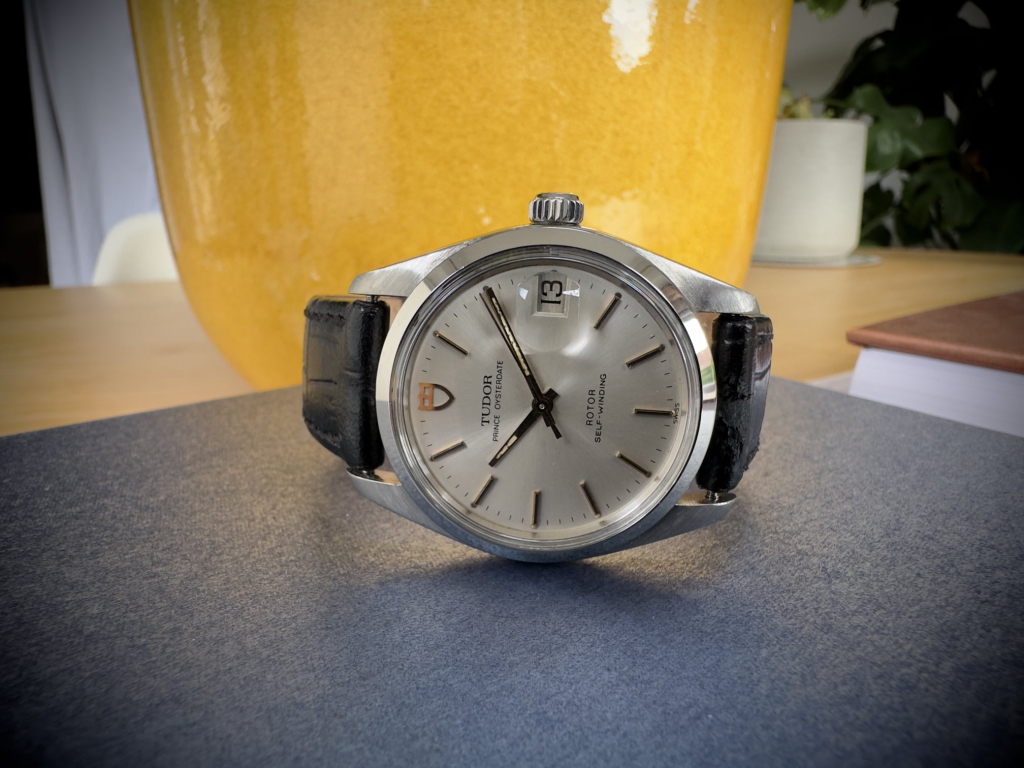
The most common bezel found on the classic models of the Prince Oysterdate is the smooth, polished stainless steel bezel, contributing to the watch’s clean and refined aesthetic.
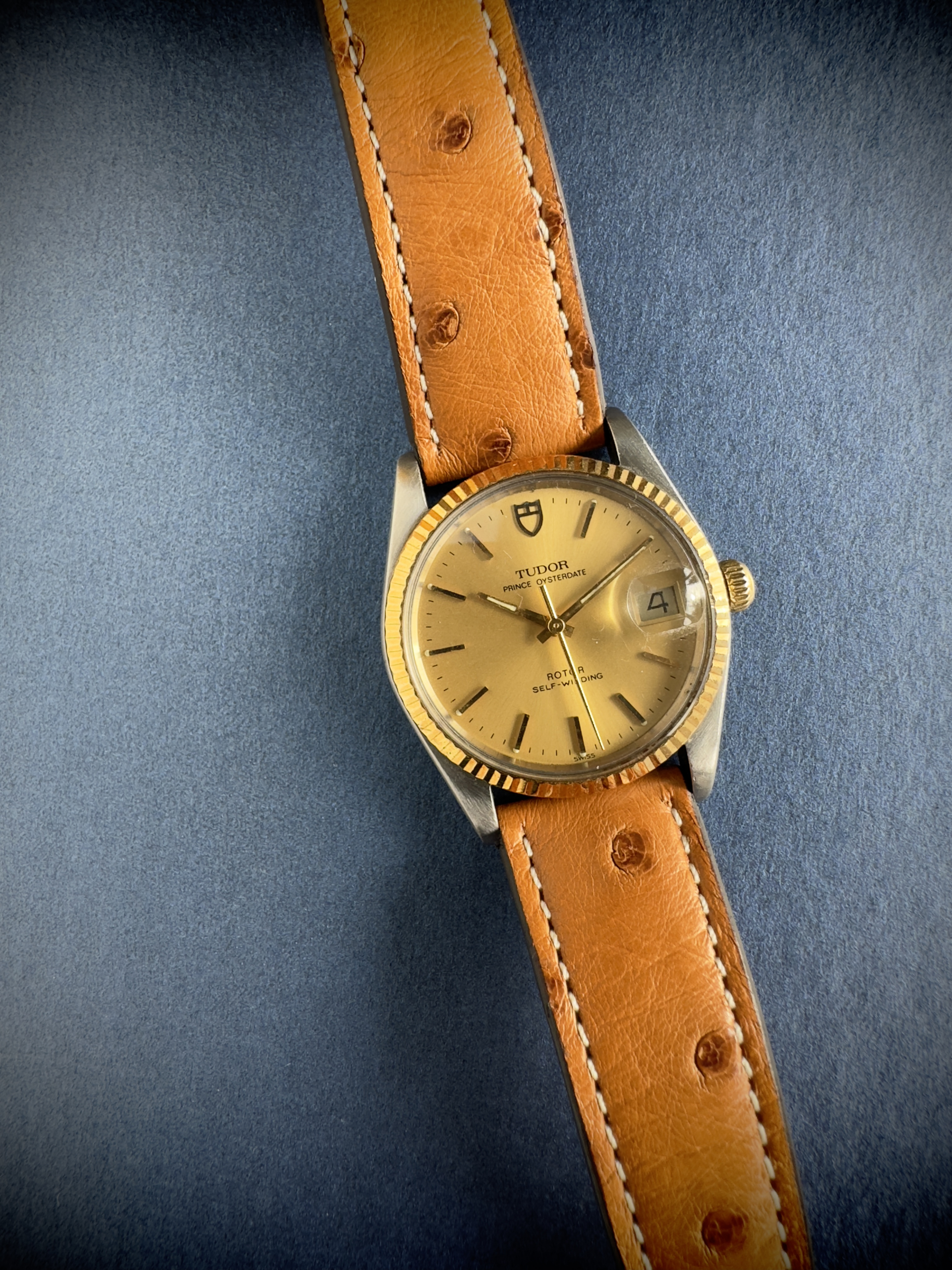
However, there are more elaborate bezels that bring a distinct character to specific Prince Oysterdate variants. For instance, the fluted bezel, often made in white or yellow gold, adds an element of luxury and sophistication to the watch. The fluting, a series of grooves carved into the bezel, catches and reflects light in a way that accentuates the watch’s presence on the wrist.
A notable variant is the engine-turned bezel, which features an intricate pattern that’s both decorative and unique. Engine-turned bezels are often seen in two-tone or gold Prince Oysterdate models, offering a striking contrast to the smooth simplicity of the steel versions.
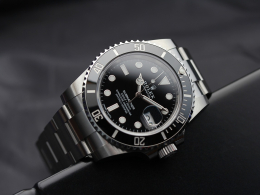
Lastly, the Tudor Submariner Prince Oysterdate models feature a unidirectional rotating bezel, an essential tool for divers to track their underwater time. These bezels are often in black or blue and are marked with minute graduations for precise timing.
Physical and Mechanical Characteristics
The Oyster case is designed to ensure the watch’s waterproofness, with a screwed-down case back and crown to keep the watch’s internals safe from dust and water. Early models were rated waterproof to 50 meters, and this was gradually improved over the decades.
The crystal is typically made of acrylic in vintage models, while later variants transitioned to sapphire crystal for better scratch resistance. The dials came in various colors, but the most common were silver, black, and blue. As for the bracelet, the Prince Oysterdate often sported the signature Oyster bracelet, known for its comfort and durability.
Inside, the watches are powered by a series of reliable automatic movements. Earlier models were equipped with the caliber 390, a reliable workhorse based on the Rolex automatic movement. Later models received upgraded movements such as the ETA 2824 and 2834, known for their accuracy and dependability.
Over the decades, the Tudor Prince Oysterdate has seen numerous variants in terms of size, material, and design. The case size has generally ranged from 34mm to 38mm, suitable for a wide range of wrist sizes. While stainless steel was the most common case material, certain models featured gold or two-tone gold and steel designs.
The Prince Oysterdate line also featured a range of dial designs, from clean and simple baton markers to more intricate designs. A notable variant is the ‘Jumbo’ models, which are larger and house a day-date complication in addition to the usual date function.
In essence, the Tudor Prince Oysterdate carries the ethos of its Rolex counterpart — quality, reliability, and timeless design — while offering its unique characteristics and a more accessible price point.