

The Omega Speedmaster Professional Moonwatch is a legend in the watchmaking world, a testament to human ingenuity, and an indelible part of space exploration history. Its legacy is as expansive as the distance in space it has traversed. This timepiece, often referred to as simply the “Moonwatch,” encapsulates the pivotal moments of human achievement and exemplifies Omega’s enduring commitment to precision, durability, and innovative design.
The Genesis of the Speedmaster
The Omega Speedmaster story begins in 1957, with the introduction of the Speedmaster Broad Arrow as part of Omega’s “Professional” line of watches, which also included the Seamaster 300 and Railmaster. Its original purpose was far from space exploration; instead, it was designed as a sports and racing chronograph, reflecting the growing trend for precision timekeeping in motorsports.
In the original Speedmaster, Omega introduced features that have since become iconic to the collection, including the triple-register chronograph layout and the high-contrast index markers.
The journey to space
The Speedmaster’s path to becoming the “Moonwatch” began in the early 1960s when NASA sought a reliable, accurate timepiece for its astronauts. After rigorous testing against extreme conditions—including temperature fluctuations, shocks, and vibrations—the Speedmaster emerged victorious, earning the title “Flight Qualified for all Manned Space Missions” in 1965.
The Speedmaster’s true claim to fame came on July 20, 1969, during the Apollo 11 mission when astronaut Buzz Aldrin set foot on the lunar surface with a Speedmaster strapped to his spacesuit. From then on, the Speedmaster became known as the “Moonwatch.” Since then, the Speedmaster has been worn on all six lunar landings, solidifying its place in space exploration history.
Physical and mechanical characteristics
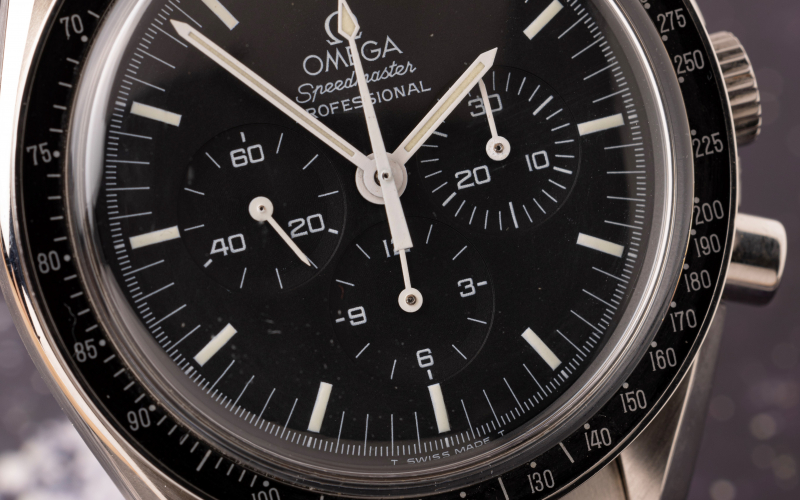
The Omega Speedmaster Professional Moonwatch has maintained a consistent design over the years, a testament to its enduring functionality and appeal. Housed within a stainless steel case—usually 42mm in diameter—is a black dial with stark white hands and markers, ensuring high visibility. The chronograph layout includes a small seconds sub-dial, a 30-minute recorder, and a 12-hour recorder.
One of the defining features of the Moonwatch is the black tachymetric bezel, used for calculating speed based on travel time. The Hesalite crystal, a type of shatterproof acrylic, is another distinctive characteristic that sets the Moonwatch apart from other watches that typically use sapphire crystal. NASA specifically requested Hesalite because it doesn’t break into tiny, sharp fragments that could potentially float around and harm astronauts and equipment in a zero-gravity environment.
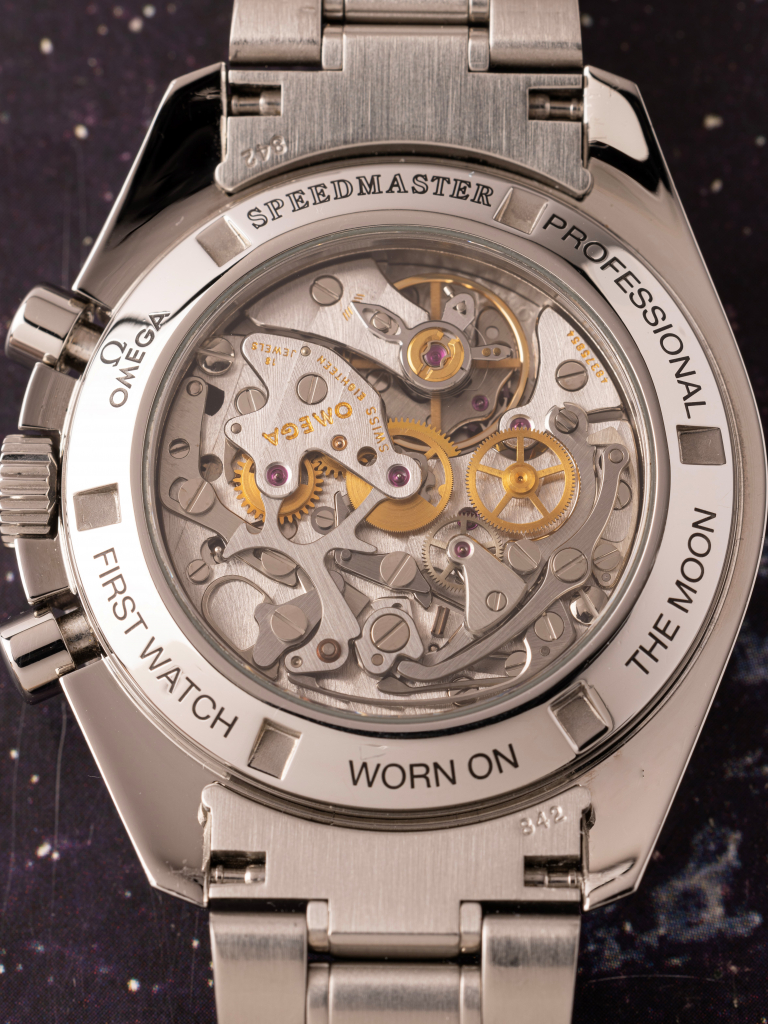
Inside, the Moonwatch originally boasted the Calibre 321, a manual-wind column-wheel chronograph movement known for its accuracy and stability. However, due to the complexity of producing this movement, Omega replaced it with the Calibre 861 in 1968, and later with the Calibre 1861 and 1863, both of which have powered the Moonwatch for several decades. In 2021, Omega reintroduced the Calibre 321, paying tribute to the original Moonwatch movement.
Omega Moonwatch references
The Omega Speedmaster Professional Moonwatch boasts a lengthy list of variants since its introduction. Here are some of the most notable references and their distinct features:
- Reference 2915 (1957-1959): The original Speedmaster model. It featured a steel bezel, broad arrow hands, and the Calibre 321 movement. It’s often referred to as the “Broad Arrow” due to its unique hand design.
- Reference 2998 (1959-1962): Introduced the “Alpha” hands and a black aluminum tachymeter bezel, replacing the steel bezel. This model was the first Omega in space, worn by astronaut Wally Schirra on the Mercury-Atlas 8 mission.
- Reference 105.003 (1963-1965): Known as the “Ed White” model, named after the astronaut who wore it during the first American spacewalk. It had straight baton hands and retained the Calibre 321 movement.
- Reference 105.012 & 145.012 (1965-1968): The first references officially qualified by NASA for manned space missions. They introduced the asymmetrical case with crown guards. These models were also the first to bear the “Professional” designation on the dial. Buzz Aldrin wore a 105.012 on the moon during the Apollo 11 mission.
- Reference 145.022 (1968-1981): Marked the shift from the Calibre 321 to the less complex Calibre 861. The dial also changed, with the Omega logo painted rather than applied.
- Reference 3570.50 (1996-2014): This model marked the shift from Tritium to Luminova (later Super-Luminova) for the luminescent material on the dial and hands. It was powered by the Calibre 1861, a slightly updated version of the Calibre 861.
- Reference 311.30.42.30.01.005 (2014-2020): This reference remained largely similar to the 3570.50 but introduced a new box set with additional accessories.
- Reference 310.30.42.50.01.001 (2021-present): The current production model, it reintroduced the historically accurate Calibre 321 movement. Other updates include a stepped dial and Dot-Over-Ninety (DON) bezel.
It’s important to note that many special editions and variations of the Moonwatch exist. For instance, the “Snoopy Award” models (3578.51 and 311.32.42.30.04.003) commemorate the Silver Snoopy Award given to Omega by NASA. Similarly, “Apollo 11” anniversary editions celebrate the moon landing, and the “Dark Side of the Moon” models (311.92.44.51.01.003 and variants) feature a black ceramic case.
The Moonwatch has also seen variations in materials and designs. From the luxe allure of the solid gold Speedmaster Apollo 11 50th Anniversary to the high-tech Speedmaster Moonwatch Dark Side of the Moon crafted entirely from black ceramic.
Every reference highlights the continuous evolution of the Omega Speedmaster Professional Moonwatch while maintaining its core identity as the watch that went to the moon.
The Omega Speedmaster Professional Moonwatch is more than just a wristwatch. It is a time-honored testament to human achievement, an iconic symbol of space exploration, and a masterclass in watchmaking design and innovation. Its enduring appeal, borne of the universal human desire to explore the unknown, continues to captivate watch enthusiasts and space aficionados alike. From the race tracks to the lunar surface, the Moonwatch remains an enduring icon of Omega’s commitment to accuracy, reliability, and the spirit of adventure.