


Unveiled in 1972, the Audemars Piguet Royal Oak transformed not only the Swiss watchmaker’s destiny but also the entire watch industry. A bold piece defined by its unique octagonal bezel, integrated bracelet, and an unconventional price tag for a steel watch, the Royal Oak was an audacious gamble that paid off, becoming an enduring symbol of luxury sports watches.
Origins and evolution
When the Swiss watch industry was on the brink of collapse due to the “quartz crisis” in the early 1970s, Audemars Piguet sought a bold strategy to survive. They turned to the visionary watch designer, Gérald Genta, who had an impeccable track record of designing iconic timepieces, including the Universal Geneve Polerouter and the Omega Constellation.
In less than 24 hours, Genta crafted the initial design of what would become the Royal Oak. The timepiece was named after the British Royal Navy battleships, which were in turn named after the tree that protected King Charles II during a battle in 1651. The octagonal bezel of the watch was inspired by the shape of the ships’ portholes.
Initially met with shock and skepticism due to its revolutionary design and hefty price tag, the Royal Oak eventually won over critics and consumers alike, redefining luxury sports watches and establishing the “jumbo” watch trend that still holds sway today.
Physical and mechanical characteristics
The first Royal Oak, reference 5402, was a study in bold contrasts. The 39mm case, considered enormous for the era, was made of stainless steel, yet priced like a gold timepiece. The finishing was equally groundbreaking: the case and integrated bracelet featured alternating polished and satin-brushed surfaces, a level of detail typically reserved for gold watches.
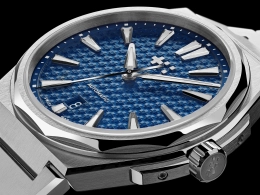
The octagonal bezel, secured with eight hexagonal white gold screws, was a stark departure from the traditional round bezels. The screws were deliberately visible, a feature that celebrated rather than hid the watch’s construction. The dial, adorned with a “tapisserie” pattern, added another layer of texture and complexity.
Inside the case was the ultra-thin self-winding caliber 2121, originally developed with Jaeger-LeCoultre, and later produced in-house by Audemars Piguet. The thinness of the movement contributed to the watch’s overall slim profile despite its large diameter.
Variants of the Royal Oak
Since the launch of the original Royal Oak, Audemars Piguet has introduced numerous variations and complications, expanding the collection while maintaining the core design ethos.
The Royal Oak Offshore, introduced in 1993, pushed the boundaries of size and ruggedness, with a chunky 42mm case, a thicker bracelet, and a more pronounced “tapisserie” pattern on the dial. It also introduced rubber-clad pushers and crown, further amplifying the sports aesthetic.
Other variants have included complications like chronographs, perpetual calendars, minute repeaters, and tourbillons. Materials have ranged from the original steel to gold, titanium, ceramic, and even carbon.
Audemars Piguet also released the Royal Oak Concept in 2002, showcasing avant-garde materials and futuristic design. More recently, the Royal Oak Selfwinding Flying Tourbillon models have provided a modern spin on this classic timepiece, offering colorful dial variants and the incorporation of a flying tourbillon for the first time in the Royal Oak collection.
Below are some notable Audemars Piguet Royal Oak references since its introduction in 1972. :
- Reference 5402 (1972-1975): The original “Jumbo” Royal Oak designed by Gérald Genta. It featured a 39mm stainless steel case, octagonal bezel, integrated bracelet, and the Calibre 2121. Known for its blue “tapisserie” dial, although a few early examples had grey dials.
- Reference 14802 (1992): Released to celebrate the 20th anniversary of the Royal Oak, this reference was a faithful re-edition of the original 5402, including the use of the Calibre 2121.
- Reference 25820 (1990s-present): This model introduced the perpetual calendar complication to the Royal Oak line. It uses the ultra-thin Calibre 2120/2802.
- Reference 15300 (2005-2012): A more modern and slightly larger (39mm to 41mm) version of the Royal Oak, powered by the in-house Calibre 3120.
- Reference 15400 (2012-2019): Replacing the 15300, this reference increased the size again to 41mm and introduced a new dial layout with a date window at 3 o’clock.
- Reference 15202 (2012-present): Launched for the Royal Oak’s 40th anniversary, this model is a modern re-issue of the original 5402, including the original 39mm size and the Calibre 2121.
- Reference 15500 (2019-present): The successor to the 15400, it retains the 41mm size and uses the new in-house Calibre 4302. The date window was shifted closer to the edge of the dial.
- Reference 26331 (2017-present): The Royal Oak Chronograph model, retaining the 41mm size and featuring the Calibre 2385. It introduced several dial color variants.
- Reference 26574 (2015-present): The Royal Oak Perpetual Calendar, increasing the size to 41mm to provide better legibility to the dial.
- Reference 15500 (2019-present): Replacing the 15400, the 15500 maintains the 41mm size but adds a few modifications, such as a wider dial and thinner bezel.
- Reference 15202BC (2022): The first Royal Oak “Jumbo” Extra-Thin model crafted in white gold with a smoked green “Evolutive Tapisserie” dial.
Variations in case materials, dial colors, and gem settings exist within these references, offering collectors a vast array of choices in the Royal Oak line.
The Audemars Piguet Royal Oak rewrote the rules of luxury timepieces and remains a paragon of daring design and horological craftsmanship. From its rebellious beginnings to its modern iterations the Royal Oak’s iconic status is firmly established.