
The Rolex GMT-Master, first introduced in 1955, is the epitome of Rolex’s dedication to producing timepieces that combine luxury, durability, and functionality. Originally developed in collaboration with Pan American Airways for their long-haul pilots, the GMT-Master was designed to display the time in two different time zones simultaneously. This iconic watch, a testament to Rolex’s innovative watchmaking capabilities, has since become a prized possession for avid travelers and watch enthusiasts alike. Let’s delve into the unique attributes and rich history of the Rolex GMT-Master through these ten detailed facts.
- Inception: The Rolex GMT-Master was first launched in 1955 in response to the needs of Pan American Airways. The airline wanted a watch for their pilots that could display two time zones simultaneously during transcontinental flights.
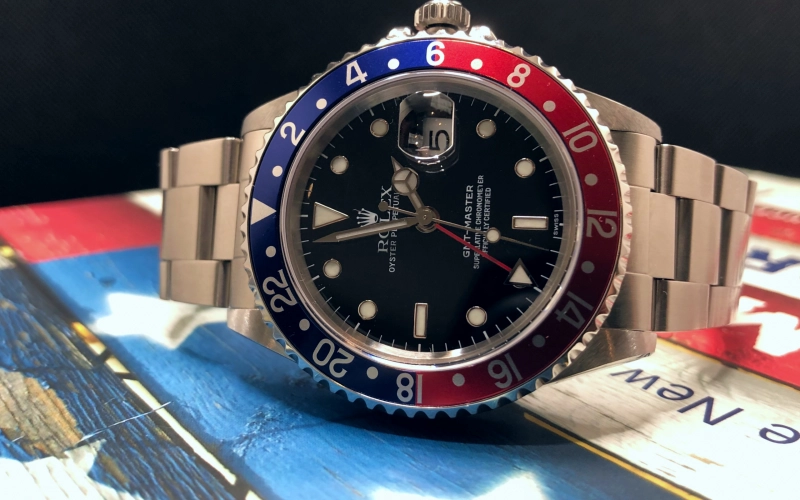
- Dual Time Zone Function: The GMT-Master features a fourth hand (in addition to the hour, minute, and second hands), which completes a rotation every 24 hours. This hand, in conjunction with the bidirectional rotating 24-hour bezel, allows the wearer to read the time in a second time zone.
- ‘Pepsi’ Bezel: One of the most recognizable features of the GMT-Master is its two-tone bezel. The original version, with a red and blue bezel, is often referred to as the ‘Pepsi’ bezel due to its resemblance to the soft drink’s logo colors.
- Variations of the Bezel: Besides the iconic ‘Pepsi’ bezel, the GMT-Master has been produced with various other color combinations over the years. These include the ‘Coke’ bezel (red and black), ‘Batman’ bezel (blue and black), and ‘Root Beer’ bezel (brown and gold or brown and black).
- GMT-Master II: In 1983, Rolex introduced the GMT-Master II, which featured an upgraded movement that allowed the standard hour hand and the 24-hour hand to be set independently, enabling the display of a third time zone.
- Movement: The latest versions of the GMT-Master II house Rolex’s Calibre 3285, an automatic movement boasting 10 patent applications filed over its development. It is praised for its high performance and its power reserve of approximately 70 hours.
- Materials: Over time, Rolex has crafted the GMT-Master using a variety of materials. Models have been made in stainless steel, yellow gold, white gold, and Rolex’s proprietary Rolesor (a combination of steel and gold) and Everose (a unique alloy of 18K rose gold) materials.
- Luminous Display: The GMT-Master features luminous markers and hands to ensure high readability in all conditions. Current models use a long-lasting luminescent material called Chromalight that emits a blue glow.
- Triplock Crown: The GMT-Master features Rolex’s Triplock winding crown. This triple waterproofness system ensures that the watch can withstand depths up to 100 meters (330 feet), despite not being specifically designed for diving.
- Role in Aviation History: The Rolex GMT-Master has been worn by many notable figures in aviation history. One significant example includes Chuck Yeager, an Air Force pilot who was the first person to break the sound barrier, who reportedly wore a GMT-Master during his historic flight.