

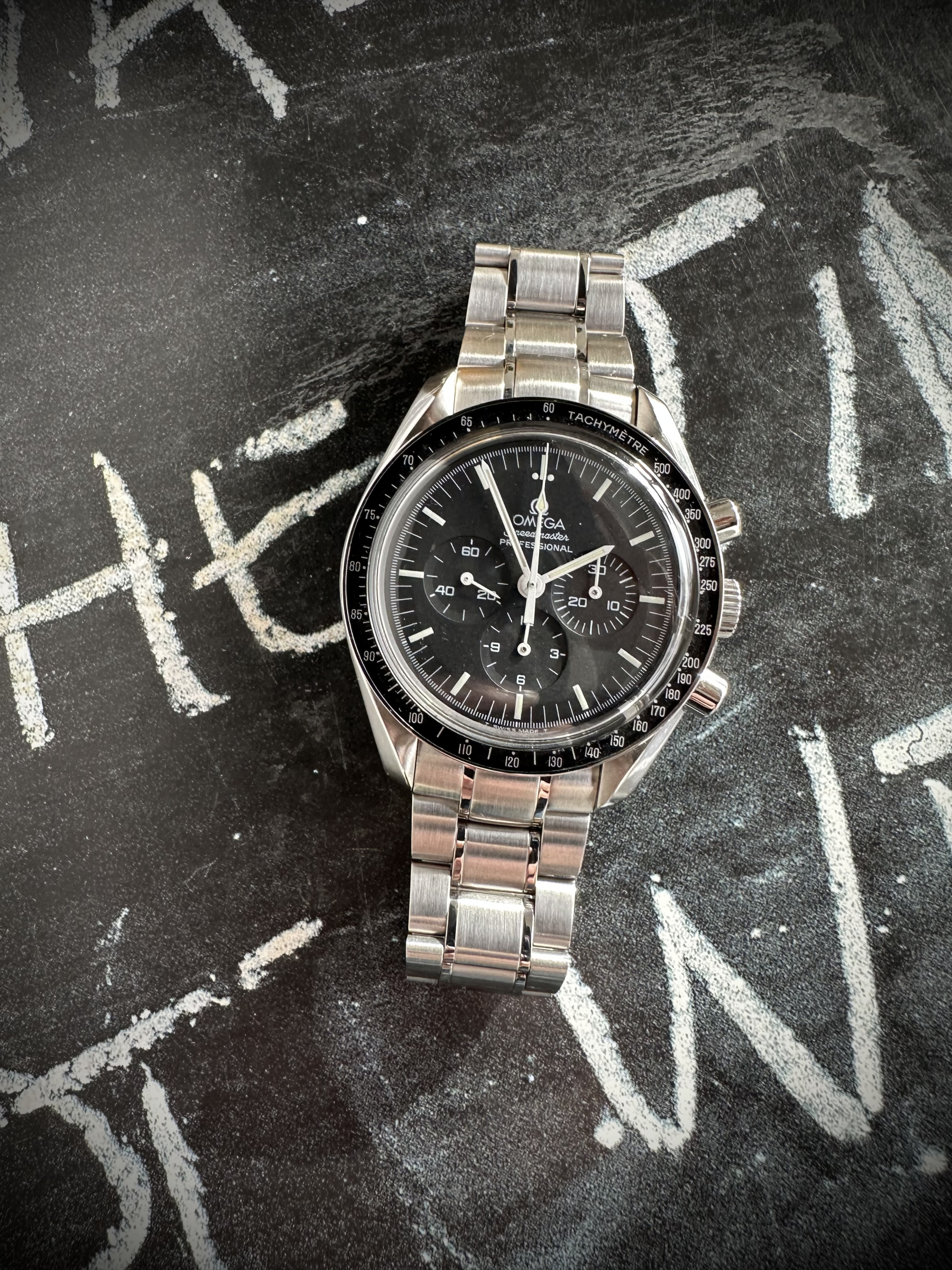
The Omega Speedmaster Professional Moonwatch is one of the most iconic and enduring watches in the world of horology. Originally introduced in 1957, its moment of glory came in 1969 when it became the first watch worn on the moon, during NASA’s Apollo 11 mission. Since then, the “Moonwatch” has become synonymous with space exploration, precision, and durability, securing its place in the annals of watchmaking history. Here are ten detailed facts about the Omega Speedmaster Professional Moonwatch:
- First Watch on the Moon: The Omega Speedmaster earned its “Moonwatch” nickname when astronaut Buzz Aldrin wore it during the first manned lunar landing on July 20, 1969. Although Neil Armstrong was the first man on the moon, he left his Speedmaster inside the lunar module as a backup because the module’s electronic timer had failed.
- NASA Certification: The Speedmaster was officially certified by NASA for all manned space missions in 1965, after passing rigorous tests under extreme conditions, including exposure to high temperatures, low temperatures, extreme humidity, shock, acceleration, pressure, and vibration.
- Manual-Winding Movement: Unlike many modern watches, the Speedmaster Moonwatch uses a manual-winding movement. The current models are powered by Omega’s Calibre 3861, a manual-winding chronograph movement with Co-Axial escapement and Master Chronometer certification.
- Chronograph Function: The Speedmaster is a chronograph, featuring a stopwatch function that is controlled by two pushers on the side of the case. The watch features a central chronograph seconds hand, a 30-minute recorder at 3 o’clock, and a 12-hour recorder at 6 o’clock.
- Tachymeter Bezel: The black bezel of the Speedmaster features a tachymeter scale, which can be used in conjunction with the chronograph to measure average speed over a known distance.
- Case and Crystal: The Speedmaster Moonwatch features a 42mm stainless steel case and either a sapphire crystal or Hesalite crystal. Hesalite, a type of acrylic crystal, was used originally as it is less likely to shatter upon impact compared to sapphire crystal, an important consideration for astronauts in a zero-gravity environment.
- Professional Designation: The “Professional” label was added to the Speedmaster dial in 1965 after the watch was certified by NASA for space missions.
- Luminescent Hands and Markers: The Speedmaster Moonwatch features luminescent hands and hour markers, ensuring legibility in low-light conditions.
- Case Back Inscription: The case back of the Speedmaster Moonwatch features the iconic inscription: “The First Watch Worn on the Moon.” Variants are available with see-through display casebacks.
- Variations and Special Editions: While the base model remains true to its original design, the Speedmaster Moonwatch is also available in various special editions and materials, including models commemorating specific NASA missions, limited edition models with meteorite dials, and models made from gold, ceramic, or titanium.